From Parking Lots to 24-Hour Gyms
Walking the streets of Bangkok lately, I have been noticing gyms more and more often, especially ones with 24-hour signs. They tend to appear in shopping districts, near office buildings, and close to rail transit stations. Through the street-facing glass you can see rows of treadmills, and the people inside working out.
Are there more of these gyms than before? Whom are they mainly serving, in these locations? My first thought was tourists. Bangkok has a great many people who visit briefly, stay a few weeks, or live here for a few months. While traveling, they may want to keep up their usual exercise habits. Not that many tourists stay in hotels with gyms, and if a gym is right near where they are staying and they can pay by the day or the week, it is very convenient.
In March 2019, Jetts management announced publicly that the brand had 14 operating locations in Bangkok; when I checked today, its official website listed 32 location entries under Bangkok.
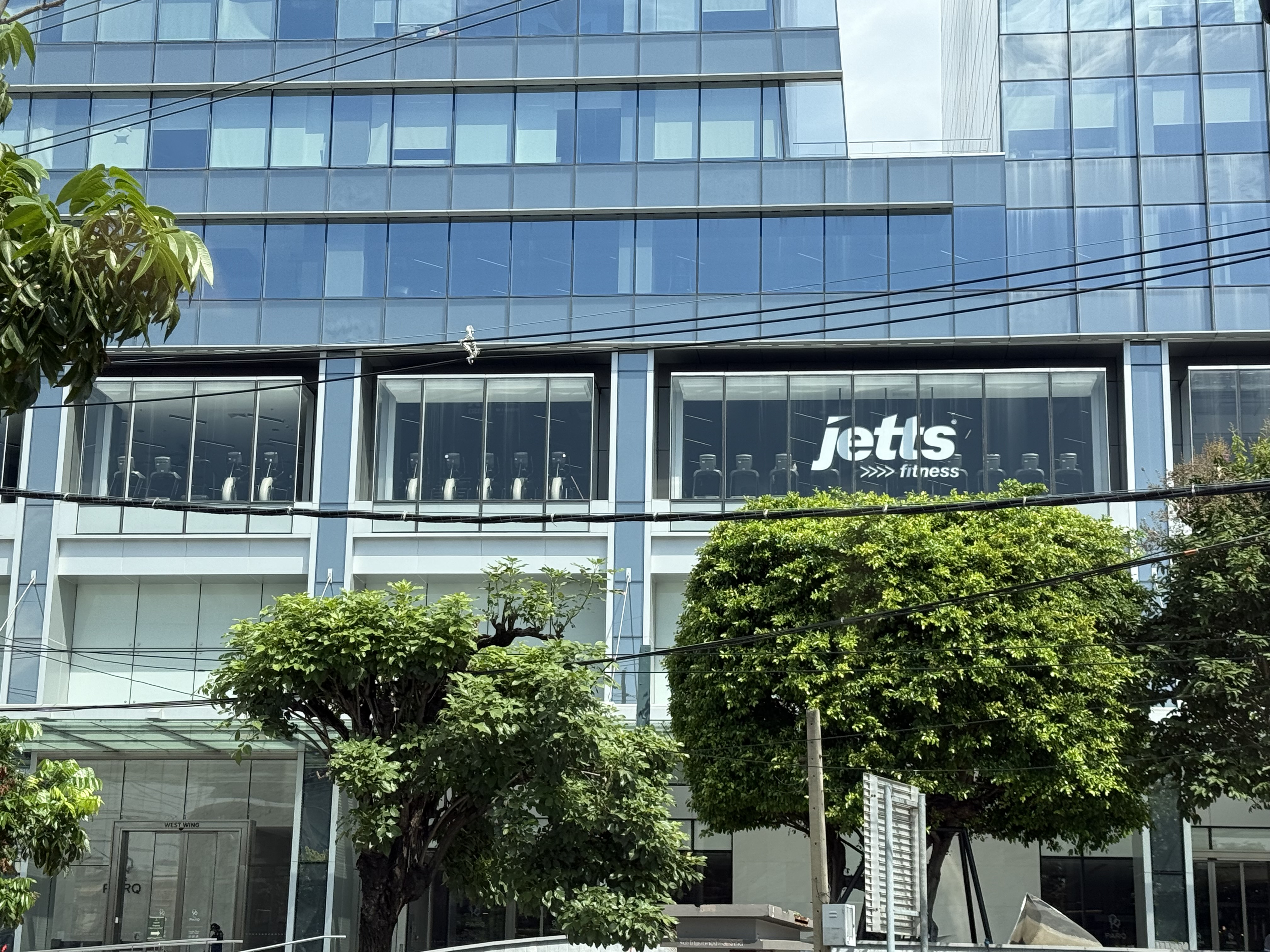
This is a photo I took today of a Jetts gym at The PARQ. Above it, the building has a continuous glass curtain wall, while the gym's level is divided by columns and beams into several bays, each with its own glass face. The machines are lined up along the windows, and the sign faces the street. Trees, power lines, and the exercise space behind the glass all came into the frame together. In some Bangkok apartment and office buildings, the lower floors hold not only the lobby but several consecutive levels of parking. So when I saw this, my first thought was whether it had been converted from what used to be parking floors.
These places are convenient for tourists, and equally convenient for people who work and live nearby. In Bangkok, a foreign face alone does not tell you someone is a tourist. Some people are visiting briefly; others have lived in Bangkok for years. A public summary released in 2025 by Kasikorn Research Center linked the growth of Thailand's fitness business to changing local exercise habits, and noted that more than 80% of the industry's revenue is concentrated in Bangkok, which is related to local purchasing power. Local demand is clearly an important part of understanding this market as well.
But tourists' needs have indeed found their way into gym product design. The Jetts website offers one-day, three-day, seven-day, and thirty-day Visitor Passes, so people staying for a short time can choose a period that suits them. The access listed for these passes is limited to staffed hours.
Next time I pass one of these gyms, I want to go in and ask at the front desk: what kind of people usually buy day passes, and where do the long-term members live? And I want to see how many people are still exercising behind the glass at night.
Text: Leo | Business Observations
Originally published in Chinese on leozhao.net as 从停车场到24小时健身房.