Between Two Cows and a Hamburger
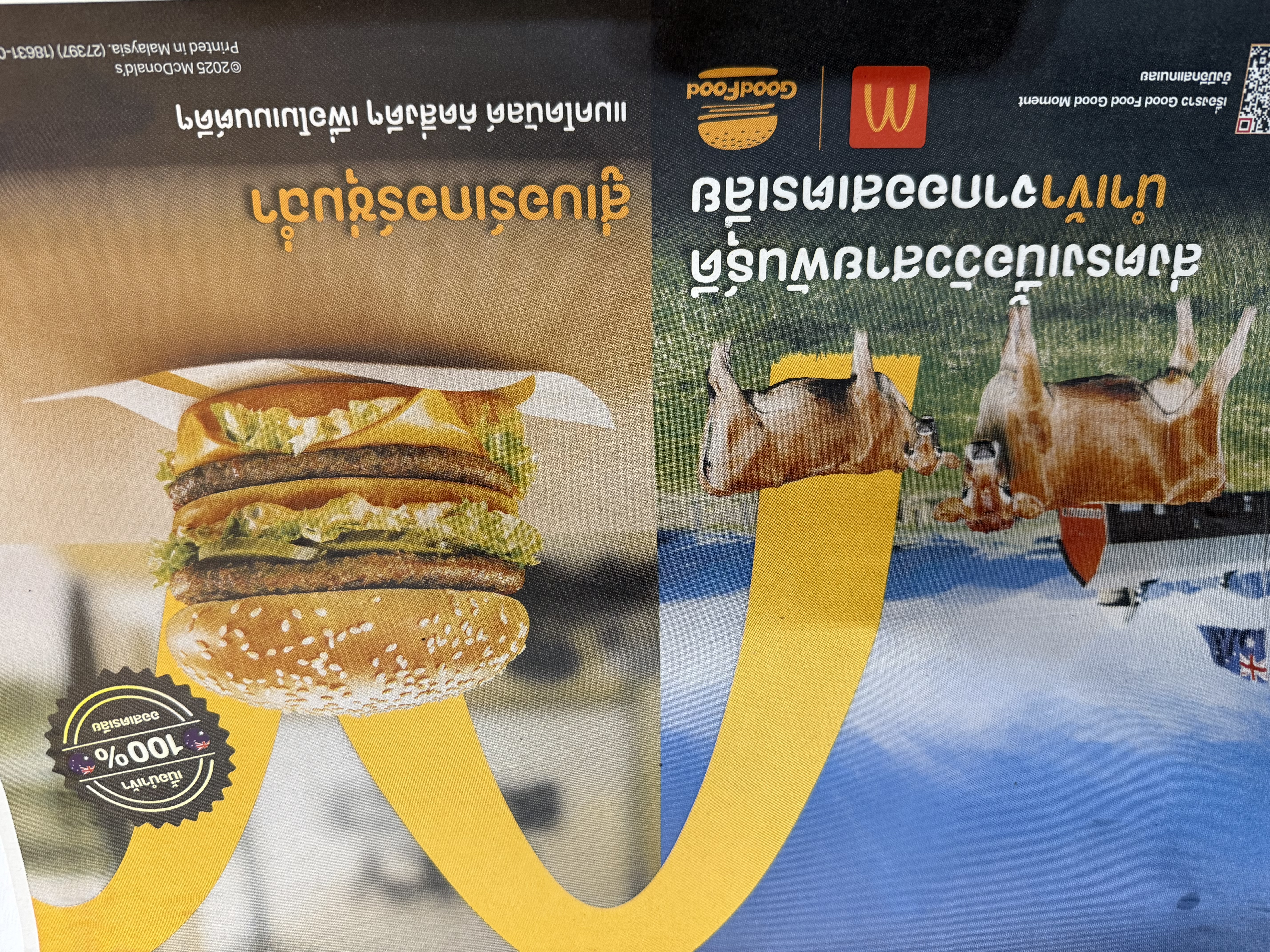
Today I took the kids to McDonald's. While we waited for our food, I looked at the advertisement on the tray liner, a very ordinary food ad. The image is split into two halves. On the left is a pasture: two cows standing on grass, with mountains and a farmhouse in the distance. On the right is a very tempting-looking double beef burger. What the ad wants to say is clear: McDonald's uses high-quality beef from Australia, and so its burgers are of better quality.
Looking at this ad, I had a very strange feeling. On the left, living cows; on the right, a finished beef burger. Especially one of the cows on the left, facing the camera head-on, looking at whoever is looking at the ad. It has an expression; it has a life of its own. On the other side, the burger has been carefully photographed, bun, beef patty, cheese, lettuce, all trying to whet the appetite.
Taken separately, neither image is a problem at all. But when they are placed side by side, do we notice that between the food we usually eat and the living form it began as, there is a gap that commercial society has created, intentionally or otherwise?
Humans have eaten animals for a very long time. Animal husbandry, agriculture, food processing, and the modern food-service system are all part of the development of human society. I am not going to simply argue over whether eating meat is right or wrong. What interests me is why the same thing, expressed in different ways, can produce such different psychological reactions.
If the left side of the ad showed only grassland, blue sky, and a farmhouse, I probably wouldn't have felt this way. It would merely be telling me that the burger's ingredients come from a place with a good natural environment. But once the ad puts two real cows in the picture, things are different. What the advertisement originally wanted us to see was the link between place of origin and product quality, yet without meaning to, it also let us see the link between life and consumption.
In modern commercial society, people are used to separating a product from the process that made it. This distance has changed the way we understand goods. We have become more and more familiar with their prices, brands, flavours, and packaging, but not necessarily as familiar with their production processes, their consumption of resources, or the lives, environments, and people who bear costs along the way.
I used to work in corporate social responsibility and risk compliance, and often had to think about the relationships between companies and people, companies and nature, companies and society.
A company's business conduct is always a matter of choosing and weighing between different interests. Consumers want better-quality food at a reasonable price; companies want to improve productivity, control costs, and make a profit; farm operators need to sustain production and income. And animal welfare, land resources, and the ecological environment are all real issues along this industrial chain.
These relationships cannot be simply sorted into right and wrong. In recent years, more and more brands have begun emphasizing product traceability, sustainable development, and supply-chain transparency. They hope to build consumers' trust in their products by showing where ingredients come from, the production environment, and certification information.
Yet letting consumers know where a product comes from and letting consumers understand how it is produced are actually two different things. Knowing where the beef comes from is not the same as knowing how the cattle were raised, how they were transported, and whether animal welfare and environmental impact were fully considered throughout production. Origin can serve as proof of quality, but it cannot automatically become the answer to every ethical question.
When a brand proactively puts a product's origin in front of consumers, it may at the same time open up questions it had no intention of discussing.
I believe the vast majority of consumers who see this ad won't think about it as much as I did. Some will see Australian beef, some will see a delicious burger, and some may not notice the two cows on the left at all. This is exactly what makes commercial communication interesting.
A brand can decide what it wants to express, but it cannot fully decide what consumers end up feeling. The same image may, for different people, evoke appetite, trust, or nostalgia, and may equally evoke sympathy, confusion, or unease.
I think the distance between these two cows and the hamburger is simply too short. So short that I couldn't, as I usually would, see the burger on the right as just a burger.
I am reminded that we often say we want business to be more transparent, companies to be more responsible, and consumers to be able to know where the goods they buy come from. But as the real world behind those goods gradually comes into view, are we also ready to understand it in all its original complexity? I don't know the answer.
Between a cow in a pasture and a hamburger on the table lies more than a food supply chain. There is also the way human beings understand the relationships among nature, life, production, and consumption.
Originally published in Chinese on leozhao.net as 两头牛与一个汉堡之间.
← Information and Corporate Social Responsibility · All writings